THE BUYER'S GUIDE / SELECTION
Choosing Spargers: Application Fit and Specification Checks
A buyer-focused guide to selecting sintered metal spargers from SHIJIAZHUANG POROYAL TECHNOLOGIES CO., LTD. It compares the published plate, spherical and anti-blocking models by head size, height, joint type, service area and listed oxygen utilization rate, and lists what to confirm before ordering.

Sparger type: plate (JTBTB), spherical (JTBQG) or anti-blocking (JTBFD)
Service area per unit: 0.28–1.19 m² for plate and spherical models; 1.44–2.56 m² for anti-blocking models
Oxygen utilization rate: 20–25% for plate and spherical; 15–20% for anti-blocking
Joint type: 1/2" for plate and spherical; 1" or 1.5" for anti-blocking (thread standard to be confirmed)
Installation envelope: head size and height (57–83 mm for plate and spherical; 306 mm for anti-blocking)
Porous material: titanium or stainless steel sintered element on a stainless steel frame; confirm chemical compatibility
Choosing Spargers: Application Fit and Specification Checks
Spargers push gas into a liquid through a porous element. How well one suits your process depends on its shape, its size, how it connects, and how much tank area each unit covers. This guide works only from the published product data for the spargers made by SHIJIAZHUANG POROYAL TECHNOLOGIES CO., LTD. (POROYAL). It is meant to help procurement teams shortlist a type and model, then confirm the remaining details with the supplier.
What the spargers are made of
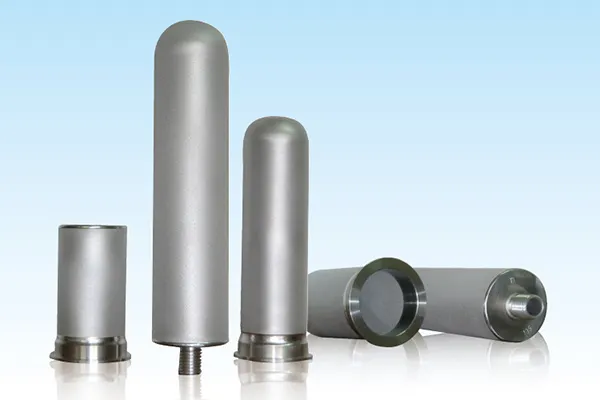
POROYAL offers three sparger designs: plate type, spherical type and anti-blocking type. Each is built from sintered porous metal, either titanium or stainless steel, on a stainless steel frame. If you are looking for an air sparger for aeration, these sintered metal elements are the relevant product group.
The product page lists these advantages:
- Small, uniform pores and bubbles
- High porosity, low aeration resistance and high aeration efficiency
- High temperature resistance and corrosion resistance
- No particles shedding from the element, so no secondary contamination of the original solution
- Suitable for aerating high-viscosity liquids
- High compressive strength and long service life
- Easy to install and replace
The source gives no numbers for temperature limits, pore size, pressure rating or service life. Treat these points as qualitative and ask for figures that match your operating conditions.
Published model data
| Type | Model | Head size (mm) | Height (mm) | Joint type | Service area (m²) | Oxygen utilization rate |
|---|---|---|---|---|---|---|
| Plate | JTBTB-100 | Φ100 | 60 | 1/2" | 0.28 | 20–25% |
| Plate | JTBTB-150 | Φ150 | 68 | 1/2" | 0.64 | 20–25% |
| Plate | JTBTB-200 | Φ200 | 83 | 1/2" | 1.13 | 20–25% |
| Spherical | JTBQG-100 | Φ100 | 57 | 1/2" | 0.37 | 20–25% |
| Spherical | JTBQG-150 | Φ150 | 76 | 1/2" | 0.83 | 20–25% |
| Spherical | JTBQG-180 | Φ180 | 82 | 1/2" | 1.19 | 20–25% |
| Anti-blocking | JTBFD-1 | 200×200 | 306 | 1" | 1.44 | 15–20% |
| Anti-blocking | JTBFD-2 | 200×300 | 306 | 1.5" | 1.96 | 15–20% |
| Anti-blocking | JTBFD-3 | 300×300 | 306 | 1.5" | 2.56 | 15–20% |
Selection criteria
1. Sparger type
- Plate type (JTBTB) and spherical type (JTBQG) models are compact, at 57–83 mm tall. They all use a 1/2" joint and have the same listed oxygen utilization rate of 20–25%.
- Anti-blocking type (JTBFD) models are much larger, with a 306 mm height and rectangular heads from 200×200 to 300×300 mm. They use 1" or 1.5" joints and cover the largest service areas (1.44–2.56 m² per unit). Their listed oxygen utilization rate is lower, at 15–20%.
The source does not say which process conditions call for the anti-blocking design or how it performs differently in service. If fouling or clogging is your main concern, describe your liquid to the supplier and ask them to confirm whether the anti-blocking type fits.
2. Service area per unit
Service area helps you estimate how many spargers a tank or basin needs. For example, if a layout is planned on service area alone, a JTBTB-100 covers 0.28 m² and a JTBFD-3 covers 2.56 m². Check with the supplier how service area was defined and whether it applies to your tank depth and layout.
3. Oxygen utilization rate
The listed ranges are 20–25% for plate and spherical models and 15–20% for anti-blocking models. The source does not give the test conditions, such as water depth, airflow or liquid type. Use these figures to compare models within this product line, not as a guarantee for your process.
4. Joint type and installation envelope
Match the joint size (1/2", 1" or 1.5") to your gas distribution piping. The source gives only the nominal size, so confirm the thread standard before ordering. Also check that the head size and height fit the space at the bottom of the vessel.
5. Porous material
The sintered element can be titanium or stainless steel. The source does not match materials to specific chemicals, so check compatibility with your liquid, gas and cleaning agents with the supplier.
When this guidance does not apply
- The published data does not cover pore size, pressure drop, airflow per unit, maximum temperature or pressure ratings. If your selection depends on these values, ask for them before you order.
- The product page does not mention certifications, pricing or lead times, so this guide makes no claims about them.
- The source lists no other sparger formats, such as disc or nozzle styles. If you need one of these, ask the supplier whether it can be made.
Information to send with an enquiry
To shortlist spargers, prepare these details: the liquid and gas involved, operating temperature and pressure, tank dimensions and depth, the target coverage area, your piping connection size and thread standard, and any fouling concerns. Use these to choose a type from the table above, then ask POROYAL to confirm the model and material.
THE PEOPLE

About the author
THE COMPANY
SHIJIAZHUANG POROYAL TECHNOLOGIES CO., LTD.
POROYAL is dedicated to the research and development of powder sintered porous filter technology, establishing itself as a leading innovator in advanced porous material solutions. POROYAL engineers deliver high-value engineering solutions to address complex product design challenges across diverse industries, including petrochemical, oilfield, water treatment, food & beverage, pharmaceutical, chemical processing, medical devices, vacuum conveying, and other specialized applications.…
About Us ↗Visit company website ↗YOUR NEXT STEP
Bring your brief. Start a useful conversation.
Use case, specification, quantity and delivery window: make the next conversation specific.
Post Time: Oct . 23, 2026 00:42